
Free SSL on Windows Server
Free SSL certificates* on IIS, installed and renewed for you
Every website you add through ServerMaid gets a free certificate from Let's Encrypt, the certificate authority trusted by every browser and used by a large share of the web. It is installed into IIS with an HTTPS redirect and renewed before it expires. No yearly certificate bill, no renewal reminder, no PowerShell script to babysit.
Included in the Websites and SSL module, £79 £39.50 per server for twelve months, unlimited websites. 30-day money-back promise.
Why SSL on Windows Server is usually a chore
On Linux a free certificate is one command. On Windows Server it has traditionally meant either buying a certificate every year and installing it by hand, or stitching together a third-party ACME client, a scheduled task, IIS bindings and a redirect rule, then hoping the renewal keeps working after the next change. When it silently stops, the first you hear of it is a browser warning on a client's site.
ServerMaid treats the certificate as part of the website, not an afterthought. It is ordered when the site is created, bound correctly, redirected, renewed on a schedule, and tested on every deployment.
What happens when you add a website
Six steps, done the same way every time
DNS is checked first
Every hostname (the domain and www) must resolve to this server. A mismatch is reported with the exact addresses before any certificate is requested, so you never burn a rate limit on a domain that is not pointed here yet.
Certificate ordered
An ACME order with Let's Encrypt using HTTP validation. The challenge is served from the site itself, so nothing extra is opened. Existing certificates can be adopted by thumbprint, or a .pfx imported instead.
HTTPS bound with SNI
An HTTPS binding per hostname on the new certificate, using Server Name Indication so any number of sites share one address. A binding pointing at the wrong certificate is re-pointed.
HTTP redirected
A 301 redirect to HTTPS is added as the first URL Rewrite rule, skipping the ACME challenge path so renewals keep working.
Renewal scheduled
A scheduled task runs the renewal every day at 03:15 and replaces the certificate well before it expires. The binding is updated in place.
Renewal tested
Every deployment checks that the task exists and fetches each hostname's challenge path with a probe file, so a renewal that would fail is caught while you are looking, not at 3 in the morning in three months.
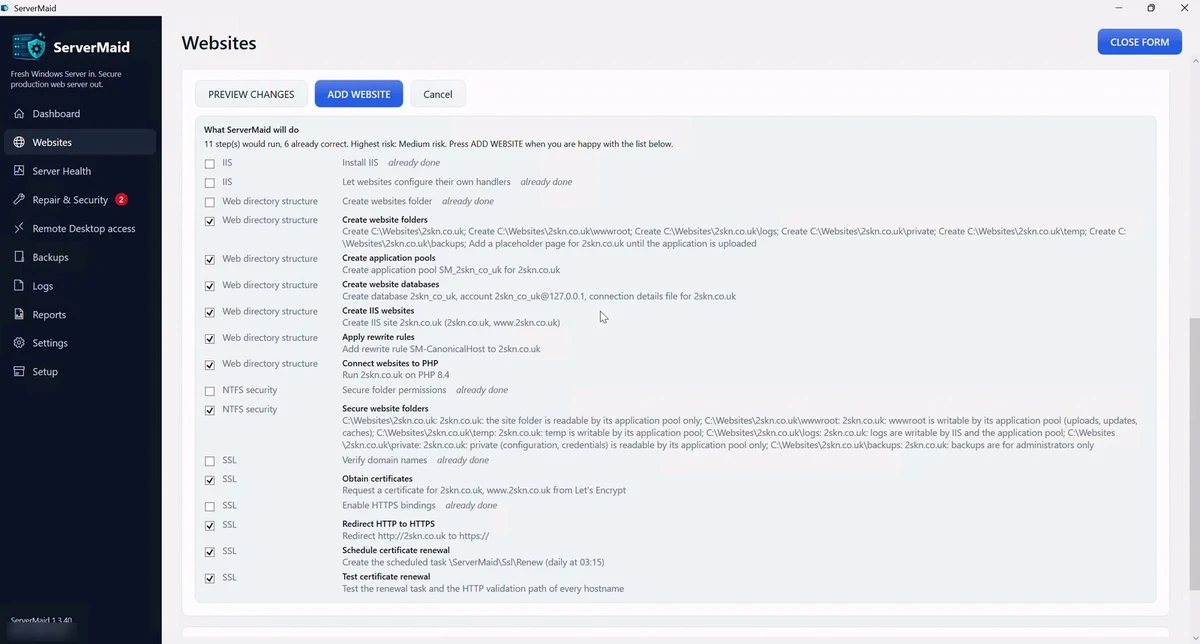
Afterwards
Certificates stay on the health score
Expiry watched
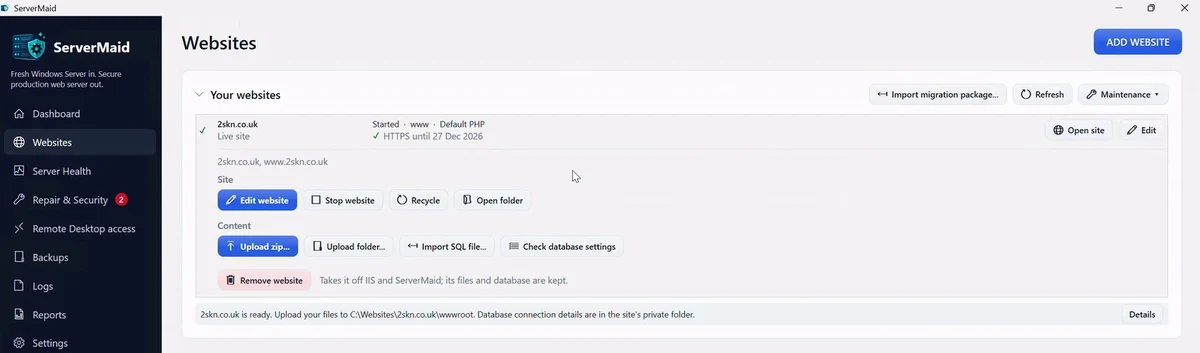
The health score deducts points when a certificate is close to expiry or a binding drifts, and says which site and why, with a Renew now action next to it.
Renew or repair in one click
The Websites page has Renew and Repair above the list. Repair re-creates missing bindings and redirect rules exactly as they should be.
Staging sites too
A staging copy of a website gets its own hostname and certificate, and is hidden from search engines, so clients can review over HTTPS without a warning.
Questions about free SSL on Windows Server
Are Let's Encrypt certificates really trusted by every browser?
Yes. Let's Encrypt is a free, non-profit certificate authority whose root is trusted by every mainstream browser and operating system. Its certificates are used on a large share of all websites.
Do I need to open any extra ports?
No. Validation uses HTTP on port 80, which a web server already serves. The challenge path is excluded from the HTTPS redirect so renewals work without any other change.
Can I use a certificate I already bought?
Yes. Choose Existing to adopt a certificate already in the Windows store by thumbprint, or PFX to import a file with its password. ServerMaid checks the private key and the names before binding it.
What if the domain is not pointed at the server yet?
The DNS check reports exactly which hostname resolves where and stops before ordering. Point the domain, press Repair, and the certificate is issued.
Does SSL depend on my licence staying active?
No. The renewal task keeps running whatever the licence state. ServerMaid never switches off anything your visitors depend on.
Stop paying for certificates and remembering renewals
The Websites and SSL module adds a website from one form: folders, application pool, database, pretty URLs and a free certificate* that renews itself. Unlimited websites on one server.
* Free SSL certificates need the Websites and SSL module (included in Agency and Enterprise licences) on a licence within its twelve-month period. Certificates come from Let's Encrypt; new websites get one while the licence is in date, and certificates already issued keep renewing.